

On 4 March 2026, we lost Toshikazu Kawasaki, a Japanese mathematician and origami artist, at the age of 70. We dedicate this installment of Recreational Personalities to remembering him through his creations.
Biography

Toshikazu Kawasaki (26 November 1955 – 4 March 2026) was a Japanese mathematician and origami artist. His name is indelibly associated with a widely folded three-dimensional paper rose and a well-known theorem in origami mathematics.
Kawasaki grew up in Fukuoka Prefecture and began designing original models when he entered Kyushu University to study mathematics. In the second year of his doctoral studies, he switched from algebraic number theory to origami geometry. In 1997 he earned his doctorate with research on transformations of the paper crane, a traditional Japanese model.1
He taught mathematics in Sasebo and later became a professor at Anan College of Technology. In 1989 he presented his research at the first international conference on origami science, in Ferrara, Italy. That same year he taught origami in Brazil at the invitation of the Japan Foundation. In 2000 he took part in the third edition of the conference at Asilomar, California.2
At Anan he led an educational project in which students folded paper to learn to recognize two- and three-dimensional shapes. He served as an adviser to the Japan Origami Academic Society. After his death at the age of 70, the society published a tribute by Jun Maekawa looking back on his work as both a mathematician and an origami artist.3
The Kawasaki Rose
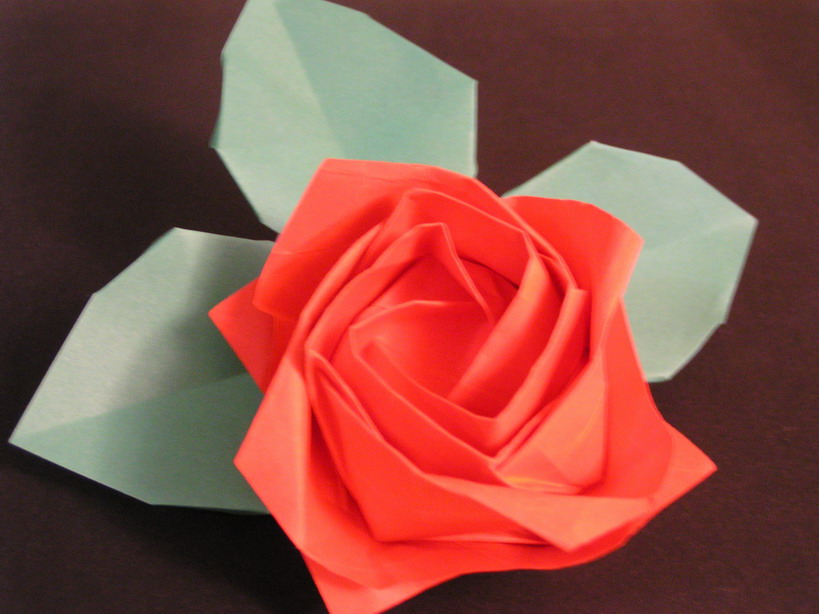
Kawasaki designed his rose around 1980. The model appeared in Japan in 1985 and reached an international audience two years later through Origami for the Connoisseur by Kunihiko Kasahara and Toshie Takahama.
The Kawasaki rose is folded from a single square sheet of paper. The creases divide the area around the center into four sectors. When the paper closes with a twist, the sectors overlap and form the spiral of the bloom. Kawasaki took inspiration from the swirls of cream on a Christmas cake. The name Kawasaki Rose later came to cover a whole family of models, from buds to open blooms. The twist also inspired other origami artists. Naomiki Sato recalls using this rose as the starting point for a five-petaled flower.4
In 2003 a version of the model became part of Fukuyama’s Rose for Peace project. That August, residents offered a total of 50,000 paper roses at the Sadako monument in Hiroshima Peace Memorial Park and at Fukuyama’s memorial to the victims of war.5
For step-by-step folding instructions, here is a tutorial for the Kawasaki rose.
The Kawasaki Cube
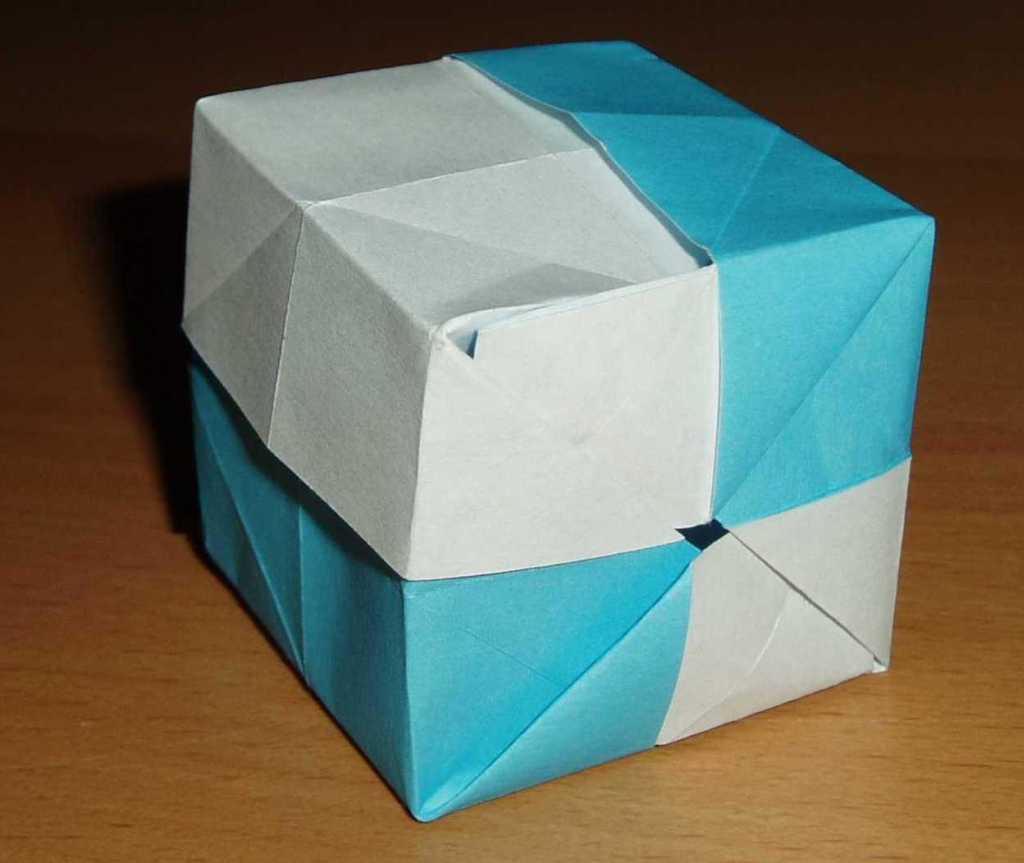
Origami for the Connoisseur also features Kawasaki Cube No. 1, folded from a single square sheet of paper. On the finished cube, half the outer surface shows the front of the sheet and half shows the back. The white and light blue areas in the photo show how the two sides alternate.
Kawasaki developed this approach to origami design, known as iso-area folding. The idea is to use both sides of the sheet as part of the design, choosing through the folds where each side will show. In the cube, the white and light blue areas add up to the same total. The same principle can be applied to flat models.
Jun Maekawa later proposed a mathematical definition of iso-area folding in his paper The Definition of Iso-Area Folding. His formulation relates the concept to rotational symmetries of the crease pattern that can swap mountain and valley folds.6
Mathematics in Origami
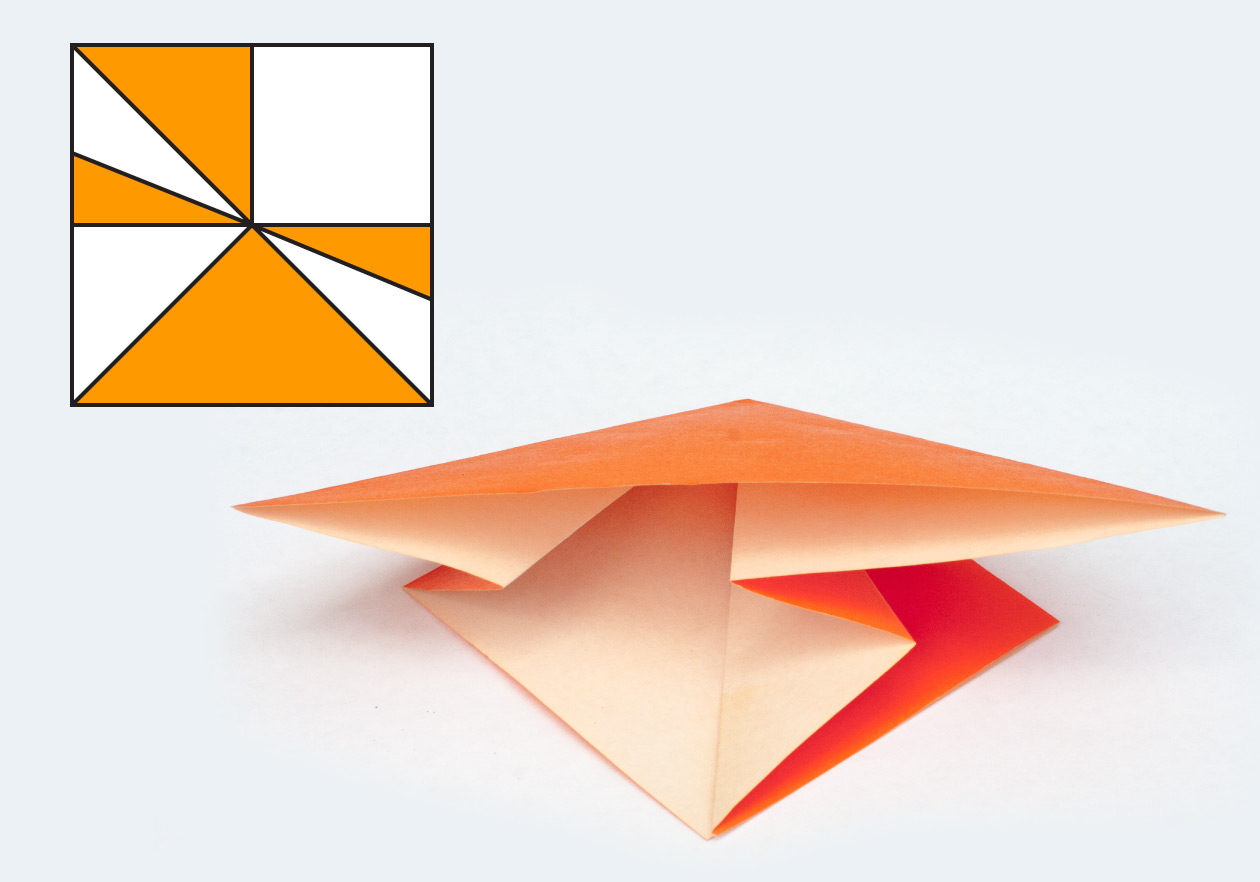
Kawasaki is remembered for an important result in origami known as the Kawasaki–Justin theorem.
When you unfold an origami model, the crease pattern remains on the sheet. Consider the case where all the creases meet at a single point inside the paper. If the sheet can fold flat, the number of creases is even and every other angle around the vertex adds up to 180°. The remaining angles also add up to 180°, since the two groups cover a full turn.
The converse of the Kawasaki–Justin theorem also holds. If the alternating angles satisfy this condition, the creases can be assigned as mountain or valley folds so that the sheet folds flat.7 For a crease pattern with several vertices, the angles can be checked at each vertex. The folds still have to be compatible across the whole sheet.
Kawasaki also studied constraints on mountain and valley assignments in a paper presented in 1989 at the First International Meeting of Origami Science and Technology. He later turned to spherical geometry. In a 2011 paper he described four basic operations for origami constructions on a sphere. In 2012 he studied how many solutions one of those operations can have.8
Books and Designs
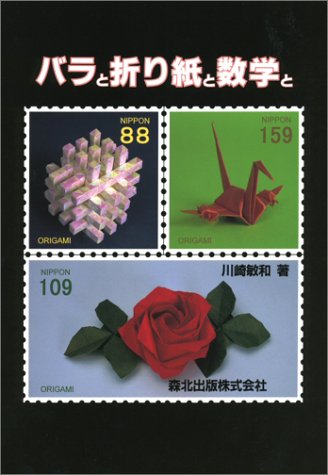
In 1998 Kawasaki published Bara to origami to sūgaku to, a title that can be translated as Roses, Origami and Mathematics. The book opens with modular constructions made by assembling several paper units, then moves on to roses. The third part covers the geometry of folding, from the conditions for a model to fold flat to the structure of the traditional paper crane.
In the Origami Dream World books, Kawasaki moves from geometric constructions to forms found in nature. The first volume was followed by Flowers and Animals, which includes the “one-minute rose.” Its name comes from how long Kawasaki took to fold it. The position of some folds can be adjusted, giving each flower a slightly different shape.
In Hakase no jitsuyō yume origami, Kawasaki folds paper into objects to use or play with. The little houses can be combined like building blocks. The book’s containers include the tamatebako, also known as the Kawasaki Box. Asahi Press presents it alongside the rose as one of his signature designs.
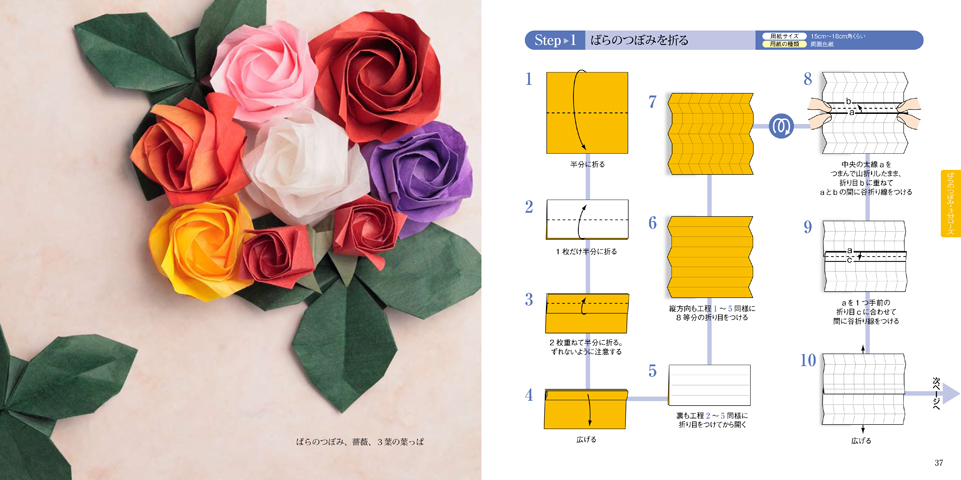
Kawasaki devoted an entire book to the rose in 2014. It appeared in English in 2016 as Rose Dream Origami. The Japanese edition came with a demonstration DVD and practice paper. The book guides readers through the sequence of folds that turns a single sheet into a three-dimensional flower.
References
- Kunihiko Kasahara and Toshie Takahama, Origami for the Connoisseur, Japan Publications, 1987.
- Toshikazu Kawasaki, Bara to origami to sūgaku to, Morikita Publishing, 1998.
- Toshikazu Kawasaki, Origami Dream World. Flowers and Animals, Asahi Press, 2003.
- Toshikazu Kawasaki, Hakase no jitsuyō yume origami, Asahi Press, 2013.
- Toshikazu Kawasaki, Rose Dream Origami, Asahi Press, 2016.
- Toshikazu Kawasaki, «On the Relation Between Mountain-creases and Valley-creases of a Flat Origami», proceedings of the First International Meeting of Origami Science and Technology, 1989.
- Toshikazu Kawasaki, «Four Origami Operations of Spherical Origami Construction», Science of Origami, vol. 1, n. 1, 2011, pp. 17–22. Paper (PDF)
-
World Origami Artists’ Exhibition profile, Origami House · Tribute by Jun Maekawa, Japan Origami Academic Society ↩
-
Biographical profile in the listing for the Japanese edition of Origami³ ↩
-
Biographical profile, Japan Origami Academic Society · Educational project report ↩
-
Rose variations, Asahi Press · Interview with Naomiki Sato, OrigamiUSA ↩
-
Jun Maekawa, The Definition of Iso-Area Folding, in Thomas Hull (ed.), Origami³, pp. 53–59. In the Gift Box section of Genuine Origami, Maekawa explicitly credits Kawasaki with introducing iso-area folding and cites his cube as an example. Contents of Origami³ · Passage in Genuine Origami ↩
-
A mountain fold forms a ridge toward the viewer, while a valley fold forms a trough. ↩
-
Proceedings of the 1989 conference · Survey by Demaine and O’Rourke · 2011 paper · 2012 paper ↩