On 4 March 2026, we lost Toshikazu Kawasaki, a Japanese mathematician and origami artist, at the age of 70. We dedicate this installment of Recreational Personalities to remembering him through his creations.
Toshikazu Kawasaki (26 November 1955 – 4 March 2026) was a Japanese mathematician and origami artist. His name is indelibly associated with a widely folded three-dimensional paper rose and a well-known theorem in origami mathematics.
Kawasaki grew up in Fukuoka Prefecture and began designing original models when he entered Kyushu University to study mathematics. In the second year of his doctoral studies, he switched from algebraic number theory to origami geometry. In 1997 he earned his doctorate with research on transformations of the paper crane, a traditional Japanese model.1
A full nine years after the previous in-depth article (in Italian), here we are talking about Gergonne’s piles again.
Let’s clear one thing up right away: the credit for returning to this topic definitely goes to my friends “Claudio” and “Chad”, who somehow managed to overcome my now almost pathological reluctance to get back to doing calculations. :)
We left off with the conjecture that the formula $L_2$ could be used for all magic cases.
The idea came from comparing, for a few configurations of the trick, the general formula derived from the work of Harrison et al.12 with a much simpler version:
\[L_2 = 1+\frac{\sum_{i=1}^{m} k_i n p^{i-1}}{p^m}.\]
The results obtained with the simulator seemed to support this intuition. However, those checks covered only a limited number of configurations: we still needed to establish whether the formula really worked for all magic cases and, above all, why.
We can now confirm that it does: in magic cases, the final position of the card is always given by the floor of $L_2$.
But there is more. The formula works not only in fully magic cases, meaning configurations in which every possible sequence leads to a uniquely determined final position.
It also holds for individual magic sequences: those particular sequences of pile reassemblies for which the card’s final position does not depend on its initial position $x$, even when the configuration as a whole is not magic.
This is not merely a lucky approximation, but a consequence of the exact formula describing the reassemblies.
Starting from this proof, we will also derive a criterion for identifying magic sequences, a condition for determining when all sequences are magic, and a formula for counting them for a given configuration.
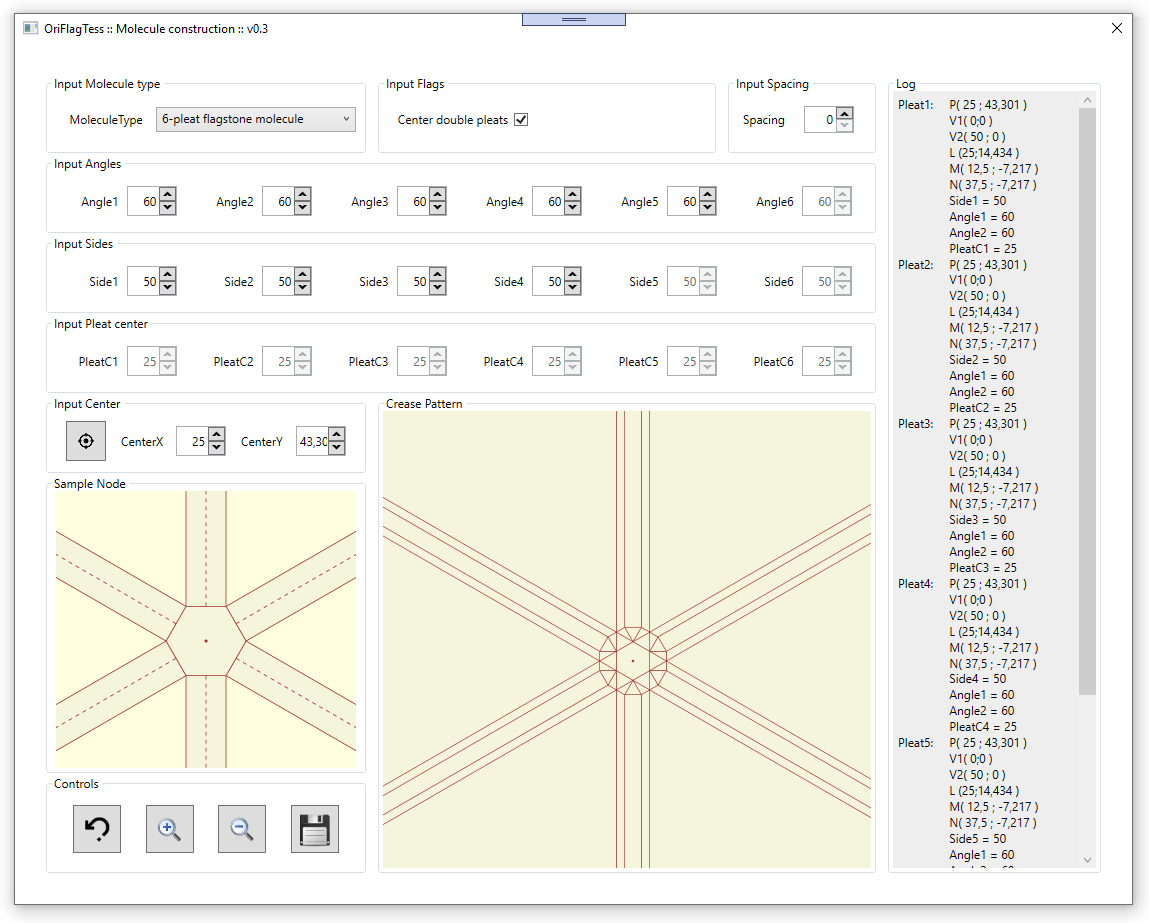
In a previous article on this blog have been showed two methods, one geometric and one analitical, for molecule construction in flagstone tessellations.
More in detail, the geometric method can be easily used in a vector graphic software (such as Inkscape) in order to design a flagstone molecule with assigned shape and dimensions.
However, if we want to design a full flagstone tessellation, made up, for instance, of several different flagstone molecules, then the use of the method may became time-consuming,
as a consequence of the increasing number of steps needed to complete each molecule.
Hence the need for a tool able to automatize these steps and to directly provide the final crease pattern of the desired molecule.
That is, the OriFlagTess software.
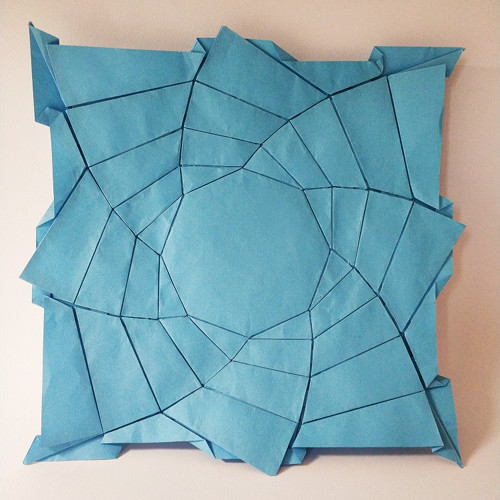
In plane geometry, the term tessellation indicates the covering of the plane with one or more geometric figures (called “tiles”) repeated infinitely, without overlapping and without spaces between them.
Similarly, in the origami world, all those models formed by equal (or even similar) “tiles” that are repeated in the surface are called tessellations.
Each tessellation is always made from a single sheet of paper properly folded.
Unlike geometric tessellations, the tessellations can be both flat and three-dimensional.
For some time now, I’ve been reviving my old interest in the art of folding paper, better known as “Origami”.
Specifically, I started again when, by chance (or maybe not), I came across the works of various artists, such as Robert J. Lang, Tomoko Fuse, Ilan Garibi and others.
It was clear that I had missed a few “steps”, and it was time to catch up.
Let’s see what this is about.
Origins
The new course of origami, or Origami 2.0 as I like to call it, has developed gradually since the 1930s, thanks to the work of the Japanese Akira Yoshizawa, the father of modern origami.
Yoshizawa introduced innovative techniques both in the design and in the realization of his works, many of which are still used today.
For example, he was the first to create four-legged animals 1 and to give three-dimensionality to his creations.
He invented the wet-folding technique (see dedicated section), now used in many forms and variations by all experienced origamists.
Last but not least, he introduced most of the symbolic notation used today to describe the folds of an origami model, known as the Yoshizawa-Randlett system.
Starting from the 50’s Yoshizawa’s works started to be known outside of Japan, and so other artists started to be interested in this new more expressionist conception of origami; in this case we remember the British Robert Harbin, but above all Neal Elias, first to use and popularize the technique of box-pleating,
well known and relevant today, among the origami techniques.