Year:
2026
Type:
Pieces:
2 identical
Material:
2 square sheets of Tant paper
Initial Size:
16 cm x 16 cm (2)
Final Size:
5.2 cm x 4.5 cm x 6.6 cm
Autore:
Pietro Vitelli
CP:
Not available
Diagrams:
Not available
Note:
The scutoid is a relatively recent three-dimensional geometric shape, identified in 2018 through the studies of Javier Buceta and Luis M. Escudero.
Its discovery originated from the observation of epithelial cells, that is, the cells that line surfaces and organs of the human body.
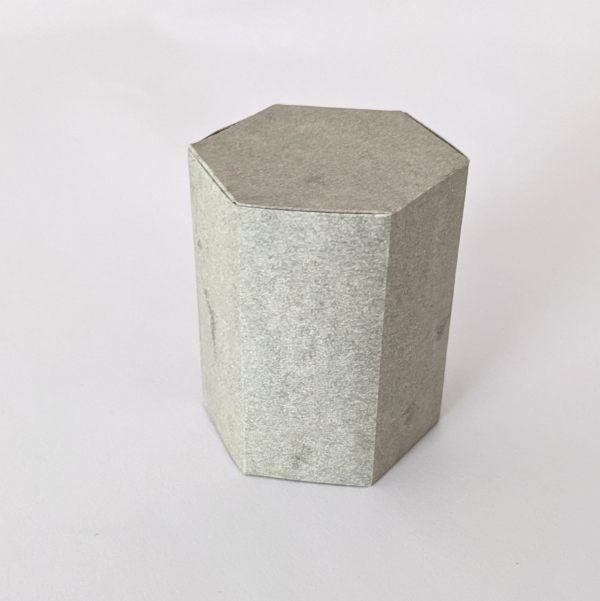
At first glance, a scutoid may resemble an irregular prism or a truncated pyramid, but it is distinguished by a fundamental characteristic: its two bases are neither parallel nor necessarily identical, and the connection between them is not linear.
The lateral faces do not follow a regular pattern, but instead develop in a more complex way, giving rise to a “twisted” geometry.
The defining feature of the scutoid is the presence of an internal vertex and of a lateral face that behaves like a hinge or a Y-shaped structure.
This configuration allows the shape to adapt to curved surfaces, creating a non-uniform transition between one base and the other.
In geometric terms, the scutoid represents a non-conventional polyhedron, in which the arrangement of edges and faces breaks the regularity of classical solids.
From a biological point of view, its importance is significant: scutoids have been identified as the natural solution adopted by cells to efficiently fill curved three-dimensional spaces, while maintaining stability and continuity between structures. In this sense, the scutoid is not only a mathematical curiosity, but a concrete example of how nature optimizes its forms to solve complex spatial organization problems.
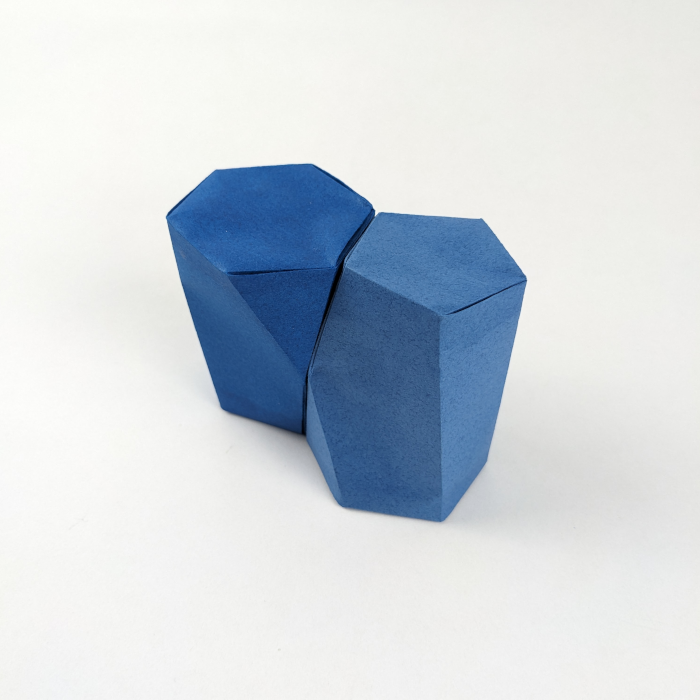
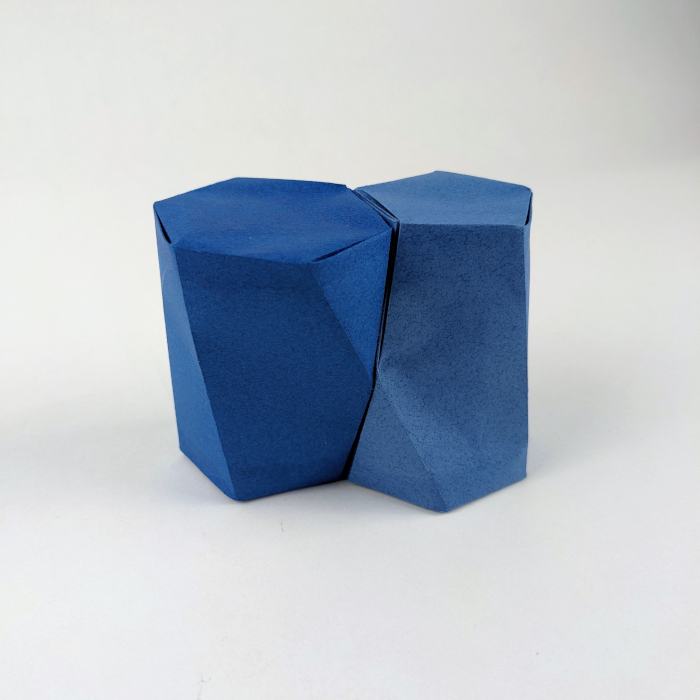
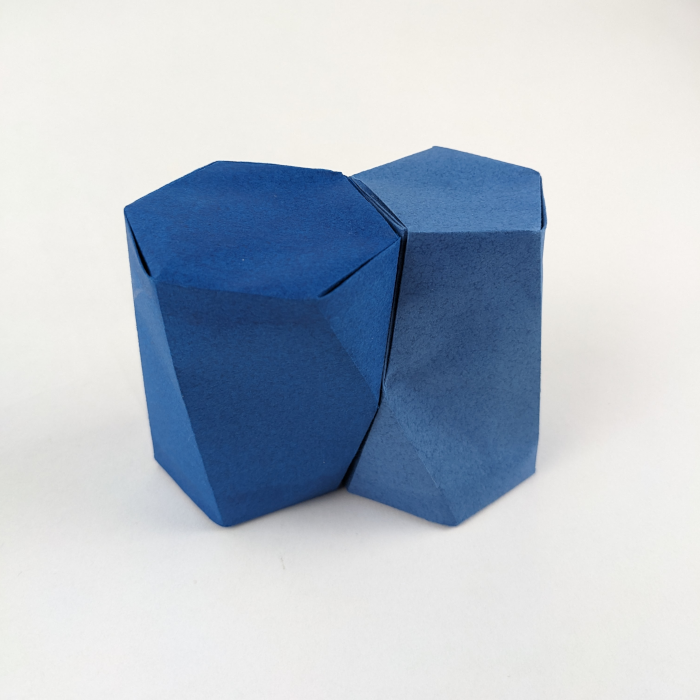
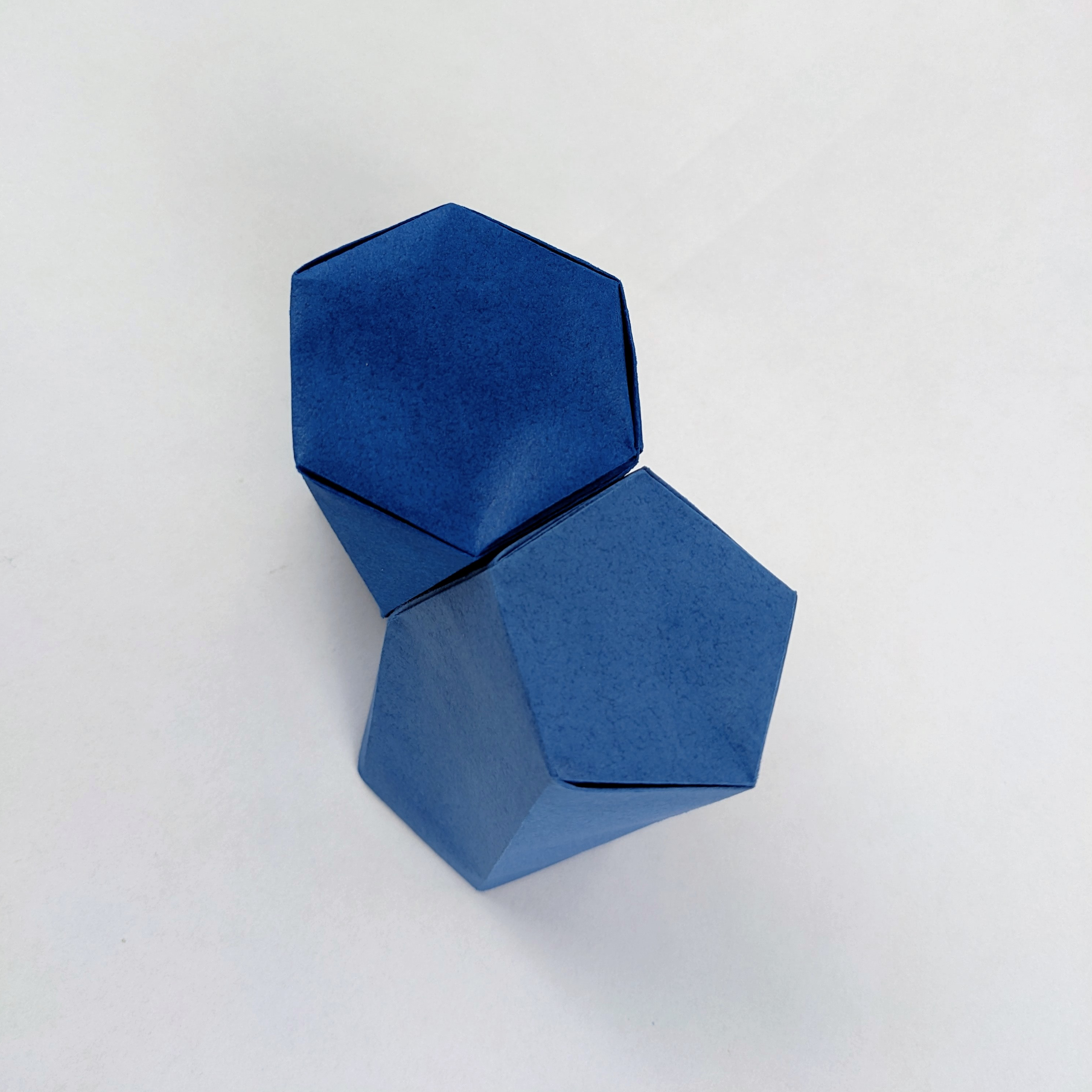
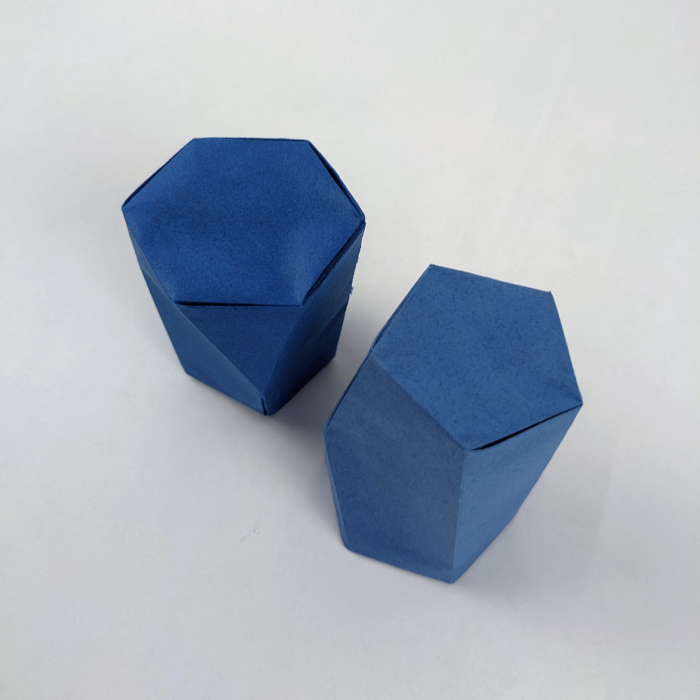
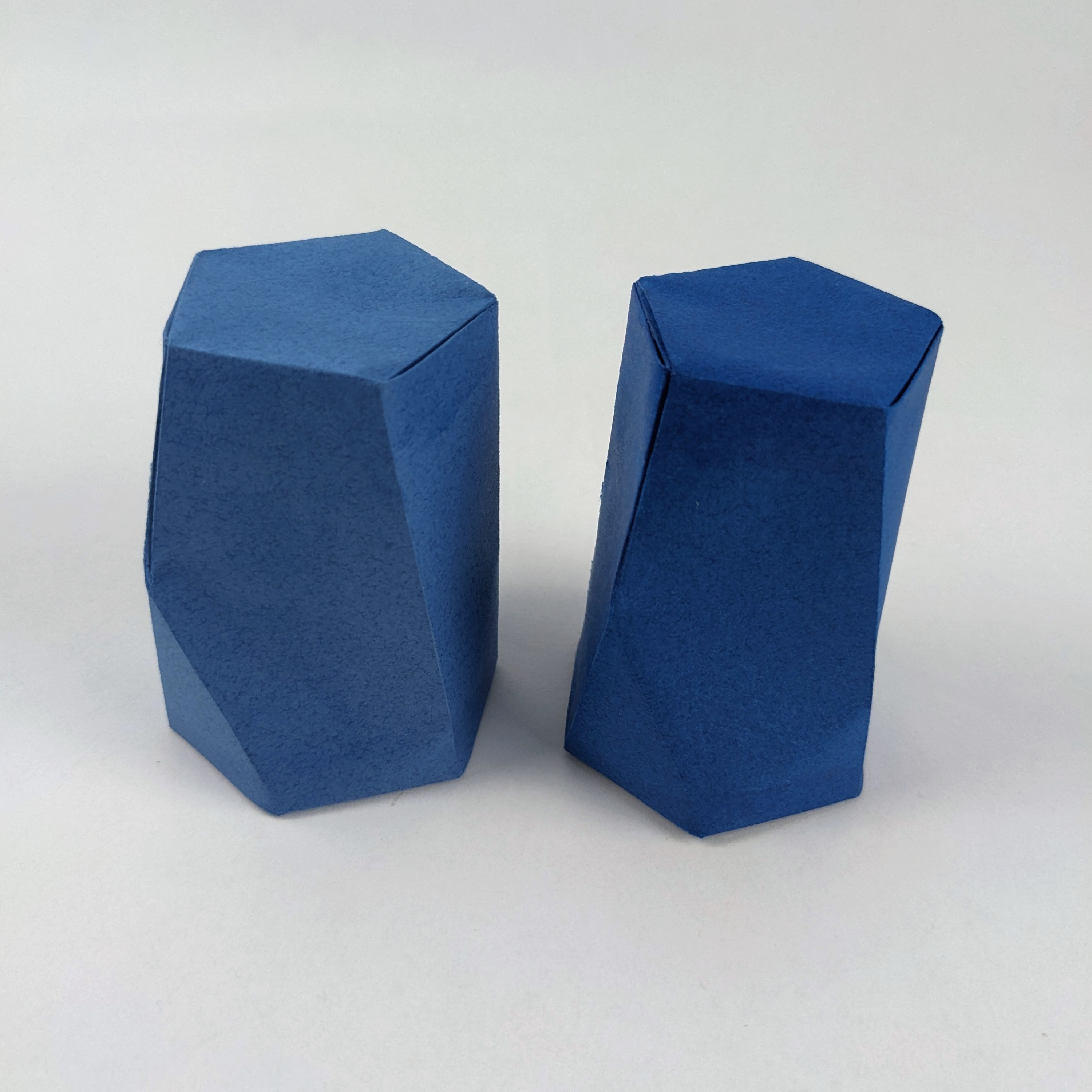
The composition represents an origami translation of the most common configuration of two identical scutoids, each characterized by a hexagonal base and a pentagonal base.
The two modules are geometrically identical and are arranged by flipping one of the two solids.
This operation makes it possible to obtain the typical configuration in which a hexagonal base is adjacent to a pentagonal base, a necessary condition for a coherent coupling between the surfaces.
In the composition, the two scutoids are positioned so that one lateral face coincides perfectly between the two elements, while all the others remain independent. The contact therefore occurs on a single surface, highlighting the way in which these shapes can be joined while maintaining their own structure.
From a constructive point of view, the two modules have the same geometry and dimensions.
The only variation is their spatial orientation, since one is flipped with respect to the other.
The alignment requires the precise coincidence of edges and vertices of the shared face.
The composition directly shows the basic configuration of pairing between scutoids, highlighting the relationship between different bases (pentagonal and hexagonal) and the role of orientation in enabling the connection between identical solids.
Its discovery originated from the observation of epithelial cells, that is, the cells that line surfaces and organs of the human body.
At first glance, a scutoid may resemble an irregular prism or a truncated pyramid, but it is distinguished by a fundamental characteristic: its two bases are neither parallel nor necessarily identical, and the connection between them is not linear.
The lateral faces do not follow a regular pattern, but instead develop in a more complex way, giving rise to a “twisted” geometry.
The defining feature of the scutoid is the presence of an internal vertex and of a lateral face that behaves like a hinge or a Y-shaped structure.
This configuration allows the shape to adapt to curved surfaces, creating a non-uniform transition between one base and the other.
In geometric terms, the scutoid represents a non-conventional polyhedron, in which the arrangement of edges and faces breaks the regularity of classical solids.
From a biological point of view, its importance is significant: scutoids have been identified as the natural solution adopted by cells to efficiently fill curved three-dimensional spaces, while maintaining stability and continuity between structures. In this sense, the scutoid is not only a mathematical curiosity, but a concrete example of how nature optimizes its forms to solve complex spatial organization problems.
The composition represents an origami translation of the most common configuration of two identical scutoids, each characterized by a hexagonal base and a pentagonal base.
The two modules are geometrically identical and are arranged by flipping one of the two solids.
This operation makes it possible to obtain the typical configuration in which a hexagonal base is adjacent to a pentagonal base, a necessary condition for a coherent coupling between the surfaces.
In the composition, the two scutoids are positioned so that one lateral face coincides perfectly between the two elements, while all the others remain independent. The contact therefore occurs on a single surface, highlighting the way in which these shapes can be joined while maintaining their own structure.
From a constructive point of view, the two modules have the same geometry and dimensions.
The only variation is their spatial orientation, since one is flipped with respect to the other.
The alignment requires the precise coincidence of edges and vertices of the shared face.
The composition directly shows the basic configuration of pairing between scutoids, highlighting the relationship between different bases (pentagonal and hexagonal) and the role of orientation in enabling the connection between identical solids.